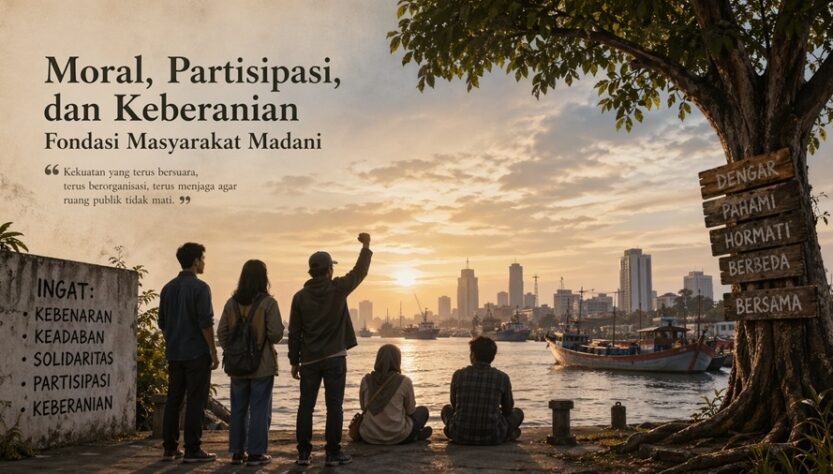
Democracy does not collapse overnight, but is eroded by latent dangers slowly. The series of terror attacks against critics since 2025 is an alarm that should wake us all up.
Silencing one voice is never enough, because behind every terrorized activist, there is a majority of people who have learned to remain silent. Molotov cocktails thrown at a critic’s house, threats and social media hacking against the head of the BEM, acid attacks on the face of a human rights activist, these are not just crimes against individuals. This phenomenon is a message addressed to everyone, that there is a price to be paid if you dare to speak out.
Also Read: Building a Civil Society Requires Courage (1)
What needs to be discussed is not only who is being terrorized, but what keeps civil society standing in the midst of such pressure. Nurcholish Madjid coined the term civil society, as a shelter for various associations, groups and movements that mediate between the state and citizens. However, a house will be strong according to the quality of its foundation. Civil society, according to Cak Nur, is not only based on the number of organizations that exist, but also on the quality of civility, the civility that supports it. The answer is the same as that which philosophers had thought of centuries before, namely morals.
Civil Society Moral Roots
Before moving into the realm of movement, it is necessary to understand what moves. Thinkers from Cicero to Kant have grappled with this question, and have always come up with no single answer. Cicero laid the moral foundation on universal reason, namely the belief that there are natural laws that apply to all humans, are transnational and between powers. For Cicero, civil society without justice was just a group of organized robbers. Kant looked further, morality was seen as not just a product of law or religion. Morality is born from the autonomous awareness that humans are ends in themselves, not instruments for anyone’s interests.
However, Adam Ferguson underlined that society does not move because of logic alone. There is sense of friendshipa sense of shared destiny, sympathy that grows naturally when witnessing other people’s suffering. It is this factor that moves activists’ feet onto the streets, not just rational calculations. In the context of Islamic religiosity, this dimension is in line with the concept love is not a cursewhich is considered a moral obligation. Speaking the truth and preventing evil is part of faith itself.

All these views, although different, are right on one thing, that is moral civil society cannot be coerced from above. Morals must grow from within, as clear reasoning from sincere solidarity, nurtured by faith that encourages courage, and passed down through consistent community traditions.
Also Read: Digital Democracy in the Shadow of Criminalization
Cak Nur mentioned as courtesycivility. Not just the values and norms of politeness, but the willingness to admit that oneself is not always right, there is not always one single answer to every problem, and differences are not a threat but a reality that must be celebrated. This is the bond of civility that is the glue in a plural community.
For the Indonesian nation, this also has a cultural dimension. Cak Nur differentiates between coastal culture which is dynamic, egalitarian and open, and inland culture which tends to be hierarchical and closed. Democracy thrives in the first place, and not coincidentally, civil movements in Indonesia often emerge from port cities and trade centers that are used to dealing with differences.
The Threatened Legacy of the Reformation
This nation has real proof that collective morals can work. The 1998 reform was a time when shared sentiment, rational awareness, and traditions of resistance met in the same momentum, then succeeded in bringing down the regime that had been in power for more than three decades. Civil society has become the foundation for democracy. Without it, only pseudo-democracy works. Twenty-seven years later, that foundation is being tested again by something much more latent and difficult to find an antidote to.
Acemoglu and Robinson, in Narrow Corridorwarned that democracy can only exist in a balance between the power of the state and the power of society. A state that is too strong breeds authoritarianism, a society that is too weak will lose the ability to supervise.
Today, the passage is getting narrower. What has happened since 2025 is not just a sporadic incident, but a pattern. The LP3ES survey found that more than 1,600 civil society organizations experienced digital repression, from account hacking to doxing and criminalization. The steps of repression have increasingly gone further, from the digital world to the physical world that threatens the body.
Also read: Democracy must be warm, not seasoned with hoaxes
The chicken carcass was sent to the critic’s home. Molotov cocktails were thrown by masked people. acid thrown in the face of a human rights activist. The fake phone rang with threats of arrest. Social media is filled with accusations of foreign stooges. It is not only veteran activists who are victims, but also students, academics, journalists and influencers, who dare to raise their voices in public spaces.
This is what is referred to as cooling effectnamely fear that spreads because everyone sees that the person speaking is being attacked without any protection. Not a single intellectual actor was caught, nor was a single case resolved. This latent impunity will only give rise to more courage for the perpetrators to carry out operations again.
Hobbes once argued that morality and justice can exist once there is an authority capable of enforcing rules. However, this assumption was born to protect. When the state stands still while its critics repeatedly fall victim, the social contract breaks down and begins to delegitimize power.
Rebuilding Participation
If there is one thing that determines the life and death of civil society, participation is the main determinant. Active, autonomous, citizen participation that arises from one’s own awareness is the main motor, not from structured mobilization driven from above.
Political participation goes far beyond elections. Every voice raised in the public sphere, every community that organizes itself to demand justice, every ordinary citizen who considers common affairs to be in his or her interests, is political participation. This is a real manifestation of popular sovereignty, as something that is not given by the state, but rather something that is born and carried out by the citizens themselves.
Also Read: Reconciling Democracy with Islam
Participation is key a sense of belonging. When residents feel they own public space, they will automatically look after it. When they feel that their voice matters, their voice will continue to rise. When participation is criminalized, what is “deliberately” damaged is the collective awareness that democracy is a common property. Civil Society who are haunted by the fear of getting involved can be diagnosed as dying from within.
That’s why rebuilding civil society must start from ensuring that participation is actively nurtured and protected. Digital literacy must encourage openness of information. Solidarity is able to maintain a sense of belonging between groups, and legal reform provides a safe guarantee for space for expression. Everything will ultimately lead to conditions where citizens feel safe, encouraged and meaningful to get involved.
However, healthy participation also requires civility as its foundation. Civil society is not an automatically good entity as a whole. Internal corruption, prejudice, and selfishness towards one’s own group can become destructive seeds from within. Civil movements that lose their civility actually give rise to conditions of chaos and pave the way for new authoritarianism to emerge. True citizenship is not only about demanding rights, but also fulfilling responsibilities to fellow citizens, communities and the nation. Rights and obligations must go hand in hand, and become the basis for the integrity of a dignified society.
That takes courage
Democracy does not collapse overnight, but is eroded by latent dangers slowly. The series of terror attacks against critics since 2025 is an alarm that should wake us all up. Not only for those who are directly targeted, but for all citizens who believe that democracy is not just an electoral ritual, but a living space where everyone’s voice is respected and protected.
Also Read: Cancel Culture, Mass Judgment, and the Ethics of Correction in Islamic Views
The power to change circumstances is not just a demand for the state to arrest the perpetrator, although that is absolutely necessary. But civil society who does not let fear overcome courage. The forces that continue to speak out, continue to organize, continue to ensure that public space does not die.
In the end, it all comes back to each individual. Are we able to strengthen the ranks between elements of civil society, and do we dare to create a new reality?
Writer: Amri Maulana, Master of Social Welfare Student, FISIP, University of Indonesia
Editor: Rara Zarary
PakarPBN
A Private Blog Network (PBN) is a collection of websites that are controlled by a single individual or organization and used primarily to build backlinks to a “money site” in order to influence its ranking in search engines such as Google. The core idea behind a PBN is based on the importance of backlinks in Google’s ranking algorithm. Since Google views backlinks as signals of authority and trust, some website owners attempt to artificially create these signals through a controlled network of sites.
In a typical PBN setup, the owner acquires expired or aged domains that already have existing authority, backlinks, and history. These domains are rebuilt with new content and hosted separately, often using different IP addresses, hosting providers, themes, and ownership details to make them appear unrelated. Within the content published on these sites, links are strategically placed that point to the main website the owner wants to rank higher. By doing this, the owner attempts to pass link equity (also known as “link juice”) from the PBN sites to the target website.
The purpose of a PBN is to give the impression that the target website is naturally earning links from multiple independent sources. If done effectively, this can temporarily improve keyword rankings, increase organic visibility, and drive more traffic from search results.